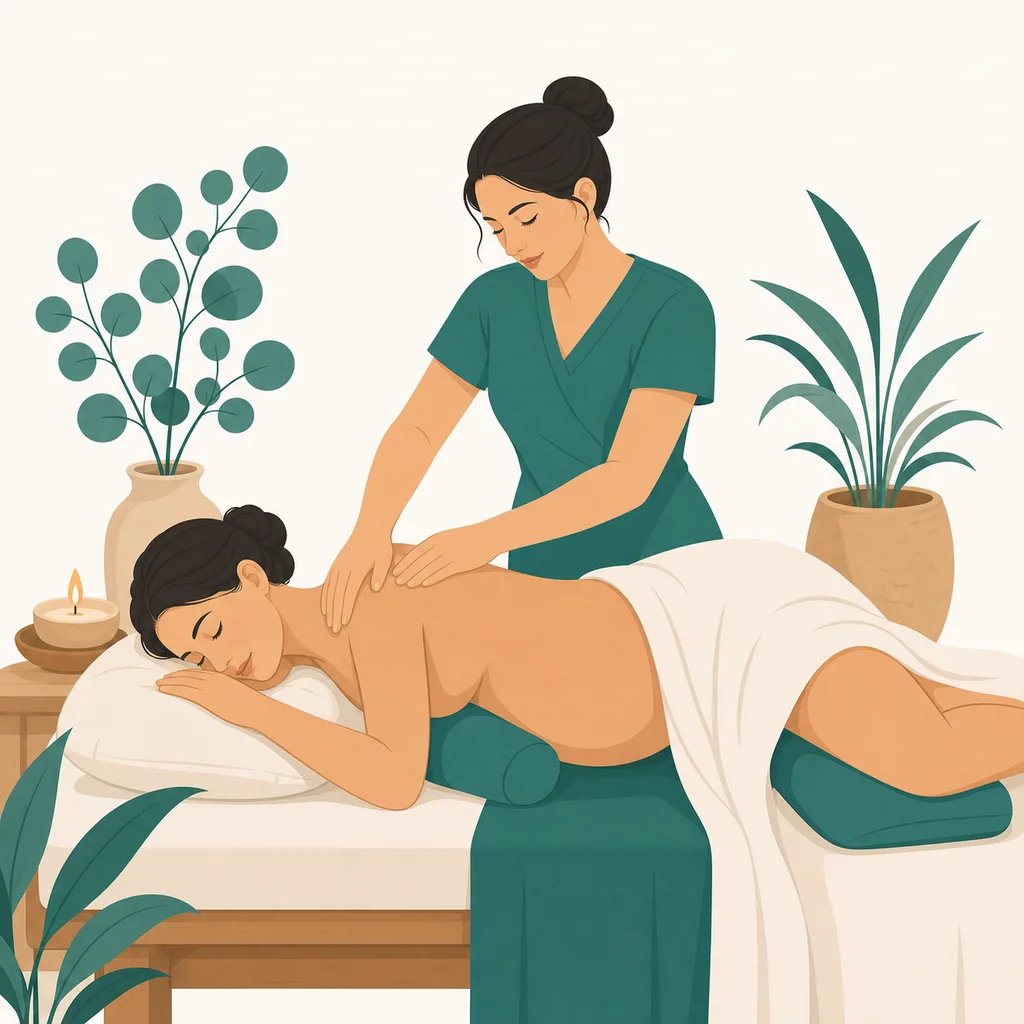
Prenatal massage can be a comfortable form of relaxation during pregnancy. Safety depends on your health, pregnancy, positioning, pressure, and the therapist’s training—not on a blanket rule that applies to every pregnant person.
Is it safe?
The American College of Obstetricians and Gynecologists says massage is a way to relax and advises side-lying rather than facedown positioning. A systematic review of 12 randomized trials reported mostly minor and transient side effects, but most trials excluded complicated pregnancies and all participants were at least 12 weeks pregnant. That evidence cannot be generalized to every pregnancy.
The benefits
- Some trial participants reported less back or leg discomfort.
- Some studies reported lower stress, anxiety, or depressive symptoms.
- A quiet, supported session may offer comfort and time to rest.
Precautions that matter
A trained therapist should use supportive positioning—often side-lying—and avoid techniques or positions that are inappropriate for the client. You may see businesses impose a first-trimester rule, but that is not a universal ACOG rule; importantly, the available randomized-trial review only included participants from 12 weeks onward. Always share your gestational stage, symptoms, complications, and clinician advice when booking. A purpose-designed prenatal massage is built around exactly these considerations.
Choosing the right therapist
Look for documented prenatal or obstetric-massage training and ask how the therapist handles positioning, health screening, pressure, and warning symptoms. TESDA’s broader Massage Therapy NC II standard lists obstetric massage among modalities, but a general credential does not by itself show extensive prenatal experience. If you usually book a different style, mention it—a gentle Swedish massage adapted for pregnancy is a common, comfortable choice.
The bottom line
Prenatal massage may be a reasonable comfort option in an uncomplicated pregnancy when the therapist is trained and the setup is adapted. It is not treatment for pregnancy complications. Seek urgent medical advice for bleeding, fluid leakage, severe headache, chest pain, shortness of breath, one-sided leg swelling, contractions, or reduced fetal movement rather than booking a massage for those symptoms.